
New vs. Old Homes: Can Both Have High Radon Levels?

Many homeowners assume that a newly built property automatically offers better protection from environmental risks. But when it comes to radon, a home's age does not determine its radon risk. A brand-new home can have elevated radon levels just like a house that has been standing for decades.
Radon is a naturally occurring radioactive gas produced when uranium breaks down in soil and rock. It is invisible, odorless, and tasteless, so it cannot be detected without proper testing. Radon can enter homes through cracks, construction joints, gaps around pipes, sump pits, and other openings between the building and the ground.
Whether your home is newly constructed or several decades old, testing is the only reliable way to know whether radon levels are elevated.
Quick Answer: Can New Homes Have High Radon Levels?
Yes. New homes can have high radon levels just as older homes do. Radon risk depends primarily on the geology beneath a property, how soil gases enter the building, foundation design, ventilation, and indoor air pressure, not simply when the home was built.
A new home is not automatically protected from radon, and an older home is not automatically at greater risk. The only way to know your home's radon concentration is to test it.
If you want to understand how radon changes throughout your home and over time, continuous monitoring can provide useful insight beyond a single test reading.
New vs. Old Homes: Radon Risk at a Glance
|
Factor |
New Homes |
Older Homes |
|
Can it have elevated radon? |
Yes |
Yes |
|
Main risk factors |
Foundation openings, airtight construction, and soil conditions |
Foundation cracks, aging seals, and soil conditions |
|
Does home age determine radon risk? |
No |
No |
|
Should the home be tested? |
Yes |
Yes |
|
Can radon levels change over time? |
Yes |
Yes |
|
Is continuous monitoring useful? |
Yes |
Yes |
The key takeaway is simple: home age does not determine radon risk. Local geology, foundation characteristics, ventilation, and pressure differences can all affect how radon enters and accumulates indoors.
What Is Radon and Why Should Homeowners Care?
Radon is a radioactive gas produced when uranium breaks down in soil and rock. Once released into the ground, radon can move through soil and enter buildings through openings in foundations and floors.
Because radon cannot be seen, smelled, or tasted, testing is essential for determining whether a home has elevated radon concentrations.
Key Facts About Radon
-
Radon is the leading cause of lung cancer among non-smokers.
-
It can enter buildings through cracks, gaps, and construction joints.
-
Indoor radon levels may vary significantly even between neighboring homes.
-
Elevated radon has been detected in homes throughout the U.S. and Canada.
-
Regular monitoring with a radon detector for home use helps identify potential exposure.
Health organizations such as the U.S. Environmental Protection Agency (EPA) and Health Canada encourage homeowners to test their homes because radon exposure can occur quietly over long periods.
Source Link: https://www.epa.gov/newsreleases/prevent-lung-cancer-testing-your-home-radon
Why New Homes Can Still Have Radon
Yes. A newly constructed home can have elevated radon even if it has modern materials, a new foundation, and energy-efficient construction.
Radon comes primarily from the soil and rock beneath and around a property, so building a new home does not eliminate the geological source of the gas.
In fact, certain characteristics of modern construction can influence how radon behaves indoors.
1. Energy-Efficient Construction: Modern homes are built with tight insulation and sealed building envelopes to improve energy efficiency. While this helps reduce heating and cooling costs, it can also trap radon gas indoors by limiting natural air exchange.
2. Slab Foundations: Many newer homes are built on concrete slab foundations. Even small cracks or openings around pipes and structural joints can create pathways for radon gas to enter living spaces.
3. Pressure Differences: Unless mechanical ventilation was planned and installed, newer airtight homes may develop negative air pressure indoors. This pressure difference will draw radon-containing soil gases upward into the house.
4. Geological Factors: Radon risk depends primarily on the soil and rock beneath a home rather than its construction date. Areas with uranium-rich soil can produce higher radon concentrations regardless of the age of the property.
Because of these factors, experts recommend radon testing for homes immediately after moving into new construction.
Are Older Homes More Likely to Have Radon?
Older homes can also have elevated radon levels. Over time, settling, foundation movement, aging seals, renovations, and changes to ventilation systems can create or modify pathways through which soil gas enters the building.
However, it would be inaccurate to say that older homes automatically have more radon. Home age alone is not a reliable indicator of radon concentration.
Common Radon Entry Points in Older Homes
-
Foundation cracks: Settling and aging can cause cracks or openings in foundations and floors.
-
Gaps around pipes and drains: Seals around plumbing penetrations may deteriorate over time, creating pathways for soil gas.
-
Exposed soil or poorly sealed floors: Some older homes may have crawlspaces, partial dirt floors, or areas that are not adequately separated from the ground.
-
Pressure differences: Indoor and outdoor conditions can create pressure differences that encourage soil gases to enter through available openings.
These conditions can develop gradually, so homeowners should consider periodic testing, especially after renovations, foundation work, HVAC changes, or other significant modifications.
Does Home Age Actually Determine Radon Risk?
No. The age of a home does not determine its radon level.
Two homes located next to each other can have different radon concentrations because of differences in foundation construction, soil conditions, ventilation, air pressure, and pathways for soil gas entry.
Instead of judging radon risk by the age of your property, homeowners should take a more practical approach:
-
Test the home.
-
Understand the results.
-
Monitor changes over time.
-
Take action if levels are elevated.
How to Test Your Home for Radon
Whether your home is newly built or decades old, testing is the only reliable way to determine its radon concentration.
Homeowners may use short-term tests, long-term tests, or continuous digital radon monitors depending on their needs.
Choosing a Radon Monitoring Device
When selecting a radon detector for home use, consider continuous monitoring, frequent readings, historical data, easy-to-understand results, and convenient setup.
A short-term test provides a reading during a specific testing period, while continuous monitoring helps homeowners understand how radon levels fluctuate over time.
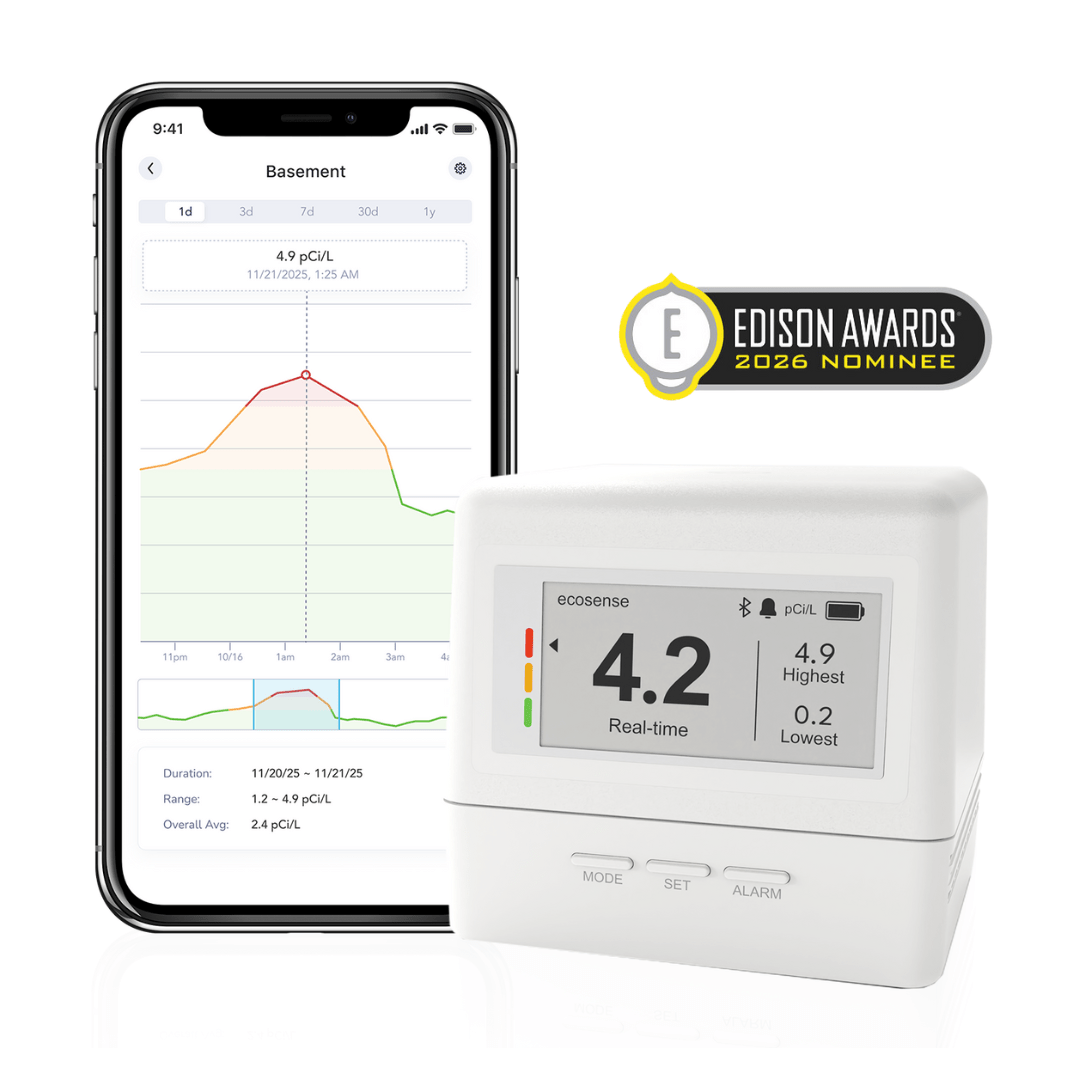
For homeowners looking for a portable option, Ecosense EcoQube Flex provides continuous radon monitoring with a battery-powered design, an always-on display, and app-based tracking for monitoring different areas of the home.
Why Continuous Radon Monitoring Matters
Radon levels can change throughout the day and over longer periods. Weather conditions, temperature, ventilation, heating systems, and differences in indoor air pressure can all affect how radon enters and accumulates inside a home. A single test can provide useful information, but ongoing monitoring can help homeowners understand these changes more clearly.
What Can Continuous Monitoring Help You Understand?
Continuous radon monitoring can help homeowners:
-
Track radon levels throughout the day
-
Identify changes or unusual increases
-
Observe seasonal patterns
-
Understand how weather and ventilation may affect readings
-
Compare radon levels in different areas of the home
-
Monitor changes after radon mitigation
-
Develop a better understanding of long-term radon patterns
This can be particularly useful in homes with multiple rooms, basements, or floors. Radon levels may differ from one area to another, so monitoring different locations can provide a more complete picture of indoor radon conditions.
A portable monitor such as Ecosense EcoQube Flex can be moved between suitable areas of the home, allowing homeowners to track and compare readings over time through the Ecosense app.
Where to Place a Radon Detector
Proper placement is important for obtaining useful readings.
For general home monitoring, consider placing the device:
-
On the lowest occupied level of the home
-
At least 20 inches (50 cm) above the floor
-
Away from windows and exterior doors
-
Away from exterior walls where possible
-
Away from high heat and humidity
-
According to the manufacturer's instructions
For homeowners using a portable monitor, moving the device between rooms can also help compare radon conditions across different areas of the property.
Always follow the manufacturer's specific placement recommendations for the device you are using.
What Should You Do If Your Home Has Elevated Radon Levels?
If testing indicates elevated radon, don't panic. The appropriate next step depends on the test method, concentration, building conditions, and applicable guidance.
A practical approach is to:
1. Test: Start by measuring radon using an appropriate testing method.
2. Understand the Results: Consider the test duration and whether additional testing is appropriate.
3. Consult a Qualified Professional: If results are elevated, consult a qualified radon professional about mitigation options appropriate for your home.
4. Continue Monitoring: After mitigation or significant changes to your home, continued monitoring can help you understand whether radon levels remain controlled.
When Should Homeowners Take Action?
In the United States, the EPA recommends taking action to reduce radon when indoor levels reach 4 pCi/L or higher. The EPA also recognizes that there is no known risk-free level of radon exposure.
Health Canada recommends corrective action when the annual average radon concentration exceeds 200 Bq/m³, which is approximately 5.4 pCi/L.
Because testing methods and local recommendations can vary, homeowners should follow current guidance from the relevant health or environmental authority and consult qualified radon professionals when results are elevated.
Even when readings are below an action level, reducing unnecessary radon exposure is a reasonable goal.
New or Old, Every Home Should Be Tested
A newly constructed home isn't automatically protected from radon, and an older property isn't necessarily at greater risk. Radon levels depend on factors such as the geology beneath the property, foundation characteristics, pathways for soil gas entry, ventilation, and indoor pressure conditions.
Because radon is invisible and odorless, testing is the only way to know whether your home has elevated radon levels. Continuous monitoring can provide additional insight into how radon levels change over time and under different conditions.
If you haven't tested your home recently, consider making radon testing part of your indoor air quality routine. Whether your home is new or decades old, knowing your radon levels is an important step toward creating a healthier indoor environment.
Frequently Asked Questions (FAQs)
1. Can a brand-new home have dangerous radon levels?
Yes. New homes are often more airtight than older ones, and too often, are not mechanically ventilated. This can trap radon more effectively inside. Regardless of construction year, radon levels are determined by the geology beneath your home, not its age. Testing with a reliable radon detector is essential for every new homeowner, ideally within the first few weeks of moving in.
2. How long does it take to detect high radon levels?
Short-term radon tests performed with charcoal kits, for example, typically take 2–7 days, while long-term tests run 90 days or more, yielding a result more indicative of the annual average concentration. Continuous digital radon monitors provide ongoing, real-time radon test results so you don't have to wait weeks. Monitoring your radon 24/7 will show exactly how your house 'breathes' and how things like the weather or your heater actually pull gas inside.
3. What is a safe radon level in a home?
The EPA action level is 4 pCi/L. However, the World Health Organization (WHO) recommends addressing levels above 2.7 pCi/L. There is no completely 'safe' level of radon; any exposure carries some risk, and minimizing it is always the goal for long-term health protection.
4. How often should I test my home for radon?
It's recommended to test at least every two years, or if you undergo a significant renovation, change your HVAC system, experience earthquakes or construction blasting nearby, or decide to spend time in a basement area not previously occupied. A continuous home radon monitor eliminates the need for periodic short-term tests by providing constant, real-time radon test results throughout the year.
5. Does the radon level change with seasons?
Yes, radon levels fluctuate significantly with seasons and weather conditions. Levels are typically higher in winter when homes are more sealed and heating systems run more frequently, and lower in summer with increased natural ventilation. Using the best home radon monitor with year-round tracking helps you fully understand your home's radon pattern and ensure you're never caught off guard by a seasonal spike.
6. Is continuous radon monitoring useful after mitigation?
It can be. Continued monitoring after mitigation can help homeowners observe whether radon levels remain controlled and identify changes that may warrant further professional evaluation.
7. Is EcoQube Flex suitable for both new and older homes?
Yes. EcoQube Flex is designed for home radon monitoring regardless of the property's age. Its battery-powered design allows homeowners to move it between rooms or floors, while the Ecosense app can save and compare readings by location.